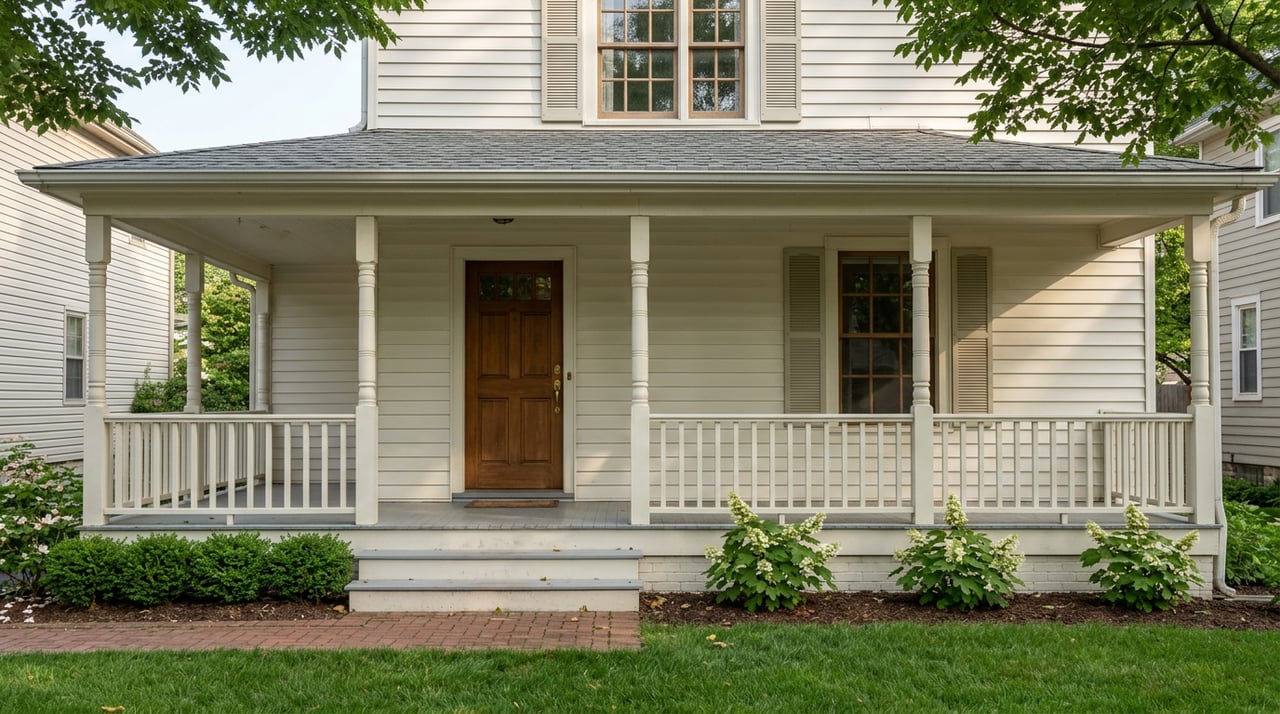
A seller in the Jefferson-Argonne Historic District decides in March that new porch railings and a rebuilt rear deck will help the house show better for a May listing. The contractor is booked. The material is ordered. If the house is a designated local landmark or a contributing property, Kirkwood's Landmarks Commission materials say it can't get a building permit until the Commission, which meets once a month, signs off on how it looks.
That's the friction sellers of Kirkwood homes face when the property is a designated local landmark or a contributing property, and it has nothing to do with financing, appraisal, or a buyer's inspector. It's sequencing. For designated local landmarks and contributing properties within Kirkwood's eight local historic districts, a Certificate of Appropriateness from the Landmarks Commission has to be issued before the Building Division will issue a permit for exterior work. The commission doesn't work on a contractor's schedule. It works on its own.
National Register status doesn't do what most sellers think it does
Plenty of Kirkwood homeowners know their block sits inside a National Register district and assume that comes with rules about paint colors or window replacements. It doesn't. The National Register, the federal listing program run through the National Park Service, is honorary. It flags historical significance and can open the door to rehabilitation tax credits, but it doesn't require anyone to clear a renovation with a review board. The city's own planning department drew that same line when it pursued National Register status for the Jefferson-Argonne and East Monroe districts, distinguishing recognition of a neighborhood's history from actual regulation of what happens to it.
The regulation comes from a separate, local designation. Kirkwood was among the first cities in Missouri to prioritize historic preservation at the municipal level, and its Landmarks Commission, established in 1981, reviews exterior changes on locally designated landmarks and contributing properties within locally designated historic districts. That's the layer that actually controls what you can do to a facade, and it's the layer most sellers don't think to check until a contractor tells them they need a permit.
Eight districts, different architectural standards
Kirkwood's local historic districts weren't all designated at once, and they don't share an architectural period. That matters because the review standards a commission applies are tied to the era and style of the specific district, not a blanket Kirkwood look.
| District | Era | Designated |
|---|---|---|
| Meramec Highlands | 1890s | 1988 |
| Central Place | 1920s | 1998 |
| Jefferson-Argonne | 1850s-1950s | 2007 |
| Savoy | Early 1950s midcentury modern | 2008 |
| Craig Woods | 1950s midcentury modern | 2011 |
| North Taylor | 1850s-1950s | 2011 |
| West Argonne | 1850s-1950s | 2014 |
| Barrett Brae | 1950s midcentury modern | 2015 |
A homeowner in Craig Woods is working against midcentury modern design guidelines. A homeowner two blocks away in Jefferson-Argonne is working against Colonial Revival and Victorian-era standards. If you're planning pre-listing work on a home in one of these districts, the first question isn't what your neighbor's contractor did last year. It's which district you're in and what era that commission is protecting.
Three property classes for the COA process
Kirkwood's own Landmarks Commission materials describe three property classes for the Certificate of Appropriateness process: local landmark, local district contributor, and local district non-contributor.
That third category is worth knowing if you're shopping in one of these neighborhoods rather than selling in one. A non-contributing property inside West Argonne or North Taylor puts you inside the walkable, tree-lined district everyone's drawn to.
The sequencing problem, spelled out
For a contributing property or a designated landmark, here's the order of operations the city requires. You apply for a Certificate of Appropriateness through the Landmarks Commission. Only after that COA is approved does the Building Division issue the permit for the work. The Landmarks Commission meets once a month, on Wednesday evenings, and applications typically need to be in the Friday before to make that month's agenda. If the commission denies the application, the owner can appeal to City Council, but only at the council's next work session, which stacks another meeting cycle onto the calendar.
Run that against a spring listing target. A seller who decides in March that they want new siding, a rebuilt front porch, or a visible addition before a May photo shoot needs the COA approved with enough runway left to still pull the permit, schedule the crew, and let the work cure or settle before staging. Miss one month's Landmarks Commission cutoff and the whole renovation calendar slides by four to six weeks, independent of how fast the contractor can move.
This is exactly the kind of project math that separates a smooth pre-listing renovation from a rushed one, and it's the reason project sequencing, not just craftsmanship, decides whether prep work actually finishes before a home hits the market.
What doesn't trigger this review, and why that matters more than people think
For designated local landmarks and contributing properties, the COA requirement is tied to exterior alterations. That matters in a city where a meaningful share of the housing stock predates 1940.
Pre-1940s Kirkwood homes commonly carry stone or pier-and-beam foundations and crawl spaces that were never built with moisture control in mind, conditions a local crawl space specialist has flagged as needing electrical and radon assessment before any encapsulation work begins, particularly where knob-and-tube wiring is still present, since those older circuits rely on open air for heat dissipation and sealing them in without an upgrade can create a fire risk. A local plumbing contractor serving Kirkwood has noted the same age pattern shows up underground, with clay tile sewer laterals that are decades old and prone to root intrusion and cracking, the kind of issue that surfaces on a sewer scope during due diligence rather than a routine walkthrough.
The practical takeaway for a seller: exterior work on a designated landmark or contributing property needs to be planned around the commission's calendar months earlier, not weeks.
A recently listed 1905 Colonial Revival on East Argonne Drive, inside the Jefferson-Argonne district, shows what that looks like when it's done ahead of time. The home carries original fireplaces, picture rail moldings, and period casings alongside a main-floor addition, a new 400-amp electrical panel, and zoned HVAC, updates that mix visible and invisible work and were completed well before the property came to market this summer at $2.2 million. That kind of layered renovation, systems upgraded and additions cleared, doesn't happen on a compressed timeline.
What this means if you're prepping to sell
If your Kirkwood home sits on the National Register, that alone changes nothing about your renovation permitting. If it sits inside one of the eight local historic districts and it's classified as a landmark or a contributing property, any exterior work needs a COA before a permit, and that means starting the commission process months, not weeks, before your target listing date. If your home is a non-contributing property inside a district boundary, that classification is worth understanding when weighing renovation plans against neighborhood character.
Listings across Kirkwood have been moving at a median of roughly a month from list to contract this summer, with citywide list prices sitting in the high $400,000s to low $500,000s as of July 2026. In a market moving that fast, a renovation delay measured in commission meeting cycles is the difference between hitting a spring window and missing it entirely.
A short FAQ
When does a property need a Certificate of Appropriateness? The COA requirement applies to a designated local landmark or a contributing property within one of the eight local historic districts.
How is a local historic district different from a National Register district? The National Register recognizes historical significance and can open access to rehabilitation tax credits, but it doesn't regulate what you do to your property. Local landmark and local historic district designation, overseen by Kirkwood's Landmarks Commission, is what actually requires a Certificate of Appropriateness before a permit.
Can I get free guidance before I submit anything? Yes. Kirkwood's Landmarks Commission materials note that any property owner in the city can seek free advice from the commission on appropriate design and preservation approach before filing a formal application, which is worth doing before a contractor's quote turns into a submitted plan.
Planning a pre-listing renovation on a historic Kirkwood property is a project management problem as much as a design one, and it's exactly the kind of sequencing Liz McDonald works through with sellers before a single permit application goes in. Work with Liz: request your free home valuation and a realistic look at what your renovation timeline actually needs to hit the market you want.
This article is general information, not legal, tax or financial advice. Consult a qualified professional about your situation.