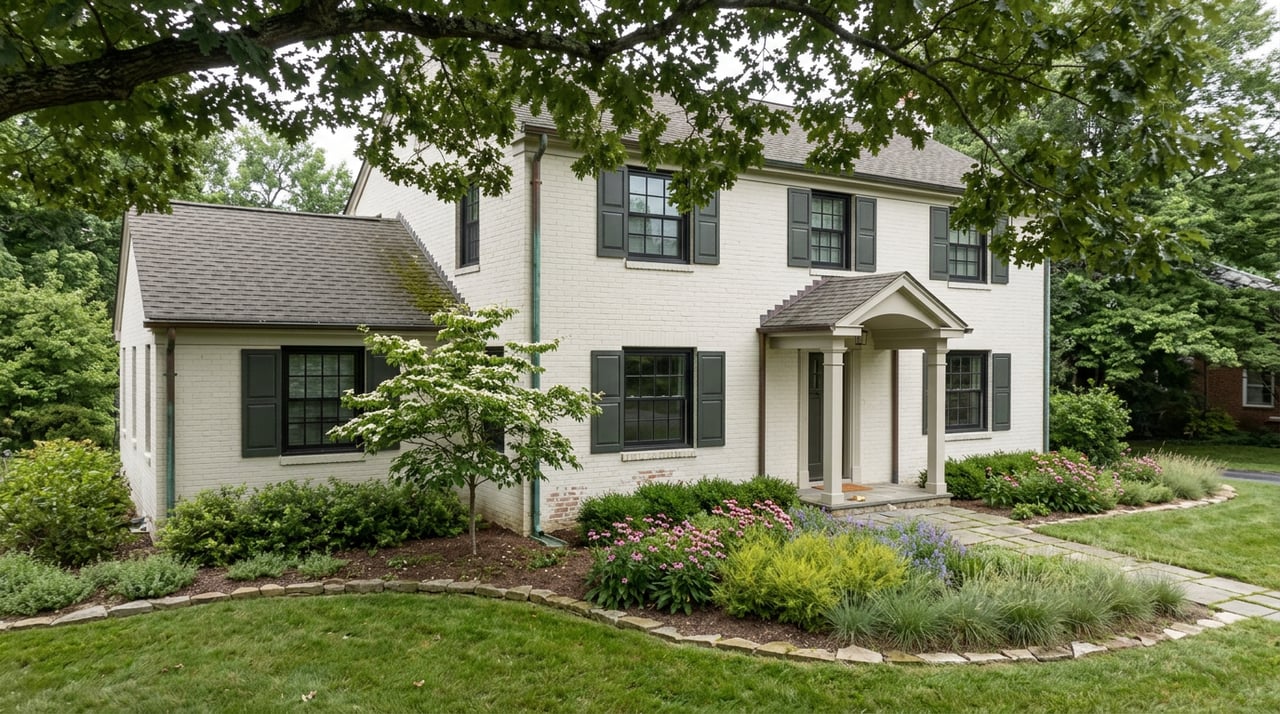
Drive down Conway or Warson in the first week of April and you will see it: a shaggy front lawn, grass gone a little wild at the edges, with a small printed sign near the curb instead of a mowing violation notice. The city put that sign there on purpose. Every April 1, Ladue waives its own grass-height ordinance for the month, a program the city calls No Mow April, built to give early pollinators a head start before anyone reaches for a mower.
It is a small rule change, and it is easy to read as a nice gesture. But No Mow April is one piece of something bigger that has been running in Ladue for close to a decade: a coordinated, occasionally slow-moving, occasionally goat-assisted civic project to turn the city's public land into working habitat. The lawns are the visible part. The real story is underground, in a sewer easement, and in the preserve behind a maintenance road that most residents drive past without a second look.
The Mulch Site With a Mayor's Name
That 14-acre parcel is Deer Creek Preserve, at 9810 S. Forty Drive, and it did not start as a park. The city bought the land from Ameren in 1988 and spent the next three decades running it as a mulch processing site for Ladue's leaf and brush program. It carried the informal name Edie's Mulch Site, after Edie Spink, who served as mayor from 1975 to 1995.
The mulch program lasted 29 years. In 2017, the city shut it down. Costs were rising, and only about 11 percent of residents were actually using the drop-off site, a participation rate low enough that the numbers no longer justified keeping it running.
That left a 14-acre parcel with no clear purpose, sitting along a tributary of Deer Creek in the middle of a residential city. What happened next took the better part of seven years.
From Master Plan to Ribbon Cutting, the Long Way
In 2019 the city received a planning grant from the Municipal Park Grant Commission and brought in a consulting firm, SWT Design, to work with Ladue's Beautification, Open Space and Tree Advisory Committee, known locally as BOSTA, on a vision for the site. Public meetings followed. That September, the City Council approved a master plan calling for a shared-use path and native landscape restoration, in place of the old mulch operation.
Then, before the city could break ground on any of it, the site got torn up anyway, just not by the parks department. From 2021 to 2023, the Metropolitan Sewer District's Deer Creek sanitary sewer replacement project cut straight through the property, delaying the very trail the city had just spent two years planning.
Phase I finally opened in 2024: an initial trail system, a bridge over the creek, scattered benches, and native tree plantings, with signage explaining the habitats along the way. According to the Garden Club of America, the work cost roughly $750,000, covered primarily by the Metropolitan Sewer District and the Municipal Grant Foundation, with the Ladue Garden Club and the Garden Club of St. Louis funding plantings on top of that. The ribbon cutting landed on Arbor Day, April 27, 2024, closing a loop that started with a planning grant five years earlier and got interrupted by a sewer crew in the middle.
Sixty-nine trees went into the ground during that first phase. Forty-three more are planned, and the city is filling that gap through something called the Living Legacy Program, which lets residents donate a tree in memory or in honor of a person, group, or pet at Deer Creek Preserve.
The Goats Have a Backup Date
This year's Arbor Day event, held May 2, fell during what the city is calling its seventh year as a Tree City USA community, a designation from the Arbor Day Foundation that requires a tree board, a tree care ordinance, and a minimum annual forestry budget. It is worth noting how recent that streak actually is. A 2022 survey by Spectrum News listed Ladue among the state's newest Tree City communities, with just three years of recognition at the time. Run the clock forward four years and three becomes seven, which lines up exactly with what the city marked this spring.
The Arbor Day celebration itself is not a ribbon-cutting formality. It includes sapling giveaways, informational booths, children's activities, and a bike ride along the DCP trail, plus a detail that tends to surprise people who haven't been to one: a rented herd from Goats on the Go, released onto the property specifically to browse down invasive bush honeysuckle. This is not a one-off stunt. BOSTA's own January 2026 meeting minutes listed a backup date for the goats, April 25, in case the main event needed to be rescheduled for weather, which tells you the city treats the goat release as infrastructure, not entertainment.
Bush honeysuckle is the reason the goats show up at all. It is the first plant to leaf out every spring, which makes it easy to spot and, according to conservation groups, easy to underestimate. Left alone, it chokes out native wildflowers and erodes creek banks, exactly the kind of ground Deer Creek Preserve was built to protect. A few miles away in Kirkwood, a longtime volunteer known locally as the Honeysuckle Slayer has spent years cutting the plant back by hand with a saw and a small pot of herbicide, and the regional nonprofit Open Space St. Louis logged 45 separate hack events across the area in 2024 alone. Ladue runs its own version of that fight every year, humans with loppers at some sites, a rented goat herd at Deer Creek Preserve.
Two Garden Tours, Not One
Come June, the honeysuckle fight gave way to something more decorative. On June 6, the city held its own free, self-guided Native Garden Tour, letting residents walk through private yards planted with native grasses, perennials, and shrubs, with homeowners on hand to answer questions.
Anyone who went looking for that event this year should know there is a second, separate tour that also features Ladue properties. The St. Louis Native Plant Garden Tour, run by the Wild Ones St. Louis chapter and the St. Louis Audubon Society's Bring Conservation Home program, was held on a different date, May 17, and covered eight private gardens split between Olivette and Ladue for a $20 ticket. Same general idea, different organizers, different calendar day. Both return most years, so it is worth checking which one you actually have circled before you show up at the wrong address.
Ladue's own native garden predates both tours. Behind City Hall sits the Ladue Native Garden, planted in 2016 by a Ladue couple working with the Audubon Society's Bring Conservation Home program and maintained since 2017 by the Ladue Garden Club. It holds more than two dozen native species chosen to bloom in sequence through the seasons, and next to it sits a small lending-library box that doubles as a seed bank, stocked when possible with seeds harvested from the garden itself for residents to take home.
The Garden Club of St. Louis has its own long-running project a short drive away at Rodes Park, on the corner of Ladue and Warson, where members have spent years planting daffodil bulbs with a local daffodil expert and a memorial dogwood tree tradition for members the club has lost. That park is now getting the same treatment Deer Creek Preserve got: a bridge, paths, and native plantings, folded into the same BOSTA-led process.
What's Next at the Preserve
Deer Creek Preserve is not finished. Since October 2025, the city has been collecting resident feedback on a Phase 2 concept: a second, looped trail and a scenic overlook along the creek, feedback the city plans to fold into a 2026 Municipal Parks Grant application. As of BOSTA's January 2026 meeting, roughly 40 residents had responded, overwhelmingly in favor, though some Twin Springs neighbors raised concerns about sightlines from the proposed overlook, prompting staff to walk the site with them directly.
Longer term, the Garden Club of America notes that Ladue and BOSTA are in discussions to extend the preserve's trail and connect it to Great Rivers Greenway, the regional network that already operates roughly 300 miles of trail across St. Louis County. If that connection happens, a former mulch site named for a mayor from the 1970s and 80s would end up linked into one of the largest trail systems in the region.
None of this is accidental, and none of it happened quickly. The shaggy lawn on your street in April, the goats at Deer Creek Preserve, the seed bank behind City Hall, and the two garden tours that both claim Ladue gardens are not separate quirks of a leafy suburb. They are the visible edges of one long-running project that a single city committee and two garden clubs have been building, one grant application and one sewer delay at a time, since 2019. If you already live here, the most useful thing you can do this year is keep an eye on the BOSTA meeting calendar. It tells you more about what your neighborhood will look like in five years than almost anything else the city publishes.
If you are weighing what a home near Deer Creek Preserve or Rodes Park is actually worth, that kind of neighborhood detail matters as much as square footage. Liz McDonald works these Ladue streets year round and can walk you through what a property like that is worth in today's market. Request your free home valuation to start the conversation.