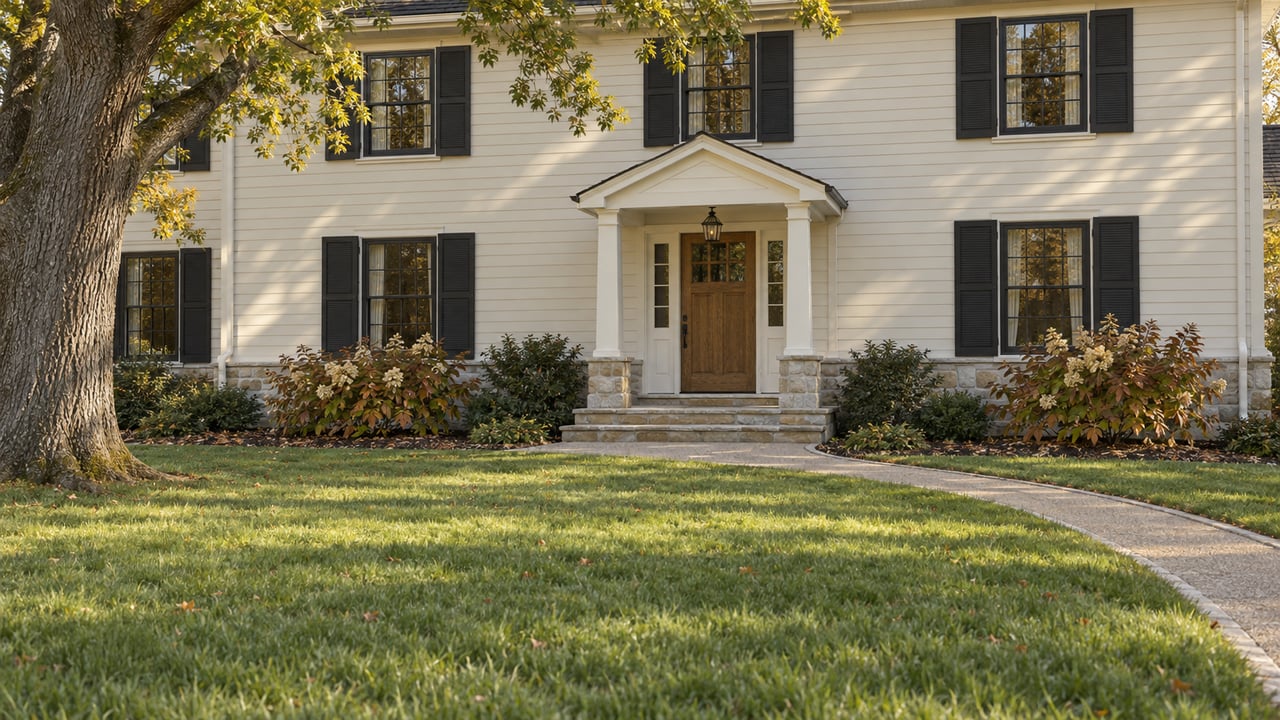
On the Full Loop at Longview Farm Park, the walk runs just under a mile. It goes past the pasture fence, through woods with small bridges over the stream beds, and comes back out by the pond with its two decks and fountain. The farmhouse sits above all of it at 13525 Clayton Road, white and tidy. It looks like a house that has always stood on 30 acres.
It hasn't. The city's own history of the park describes a farm that once covered more than 350 acres. Over about 150 years it was deeded, sold, enlarged, split and built on. The park is the part that never got subdivided. What the city has done there since 2000 has been to keep that last piece working as a farm and as a place where Town and Country gathers.
Named for a View, in the Early 1930s
The name is newer than the farm. Edward Noland bought 75 acres of the property in the early 1930s. He called it Longview Farm because of the distant view it gave of downtown St. Louis. The Nolands first used it as a weekend and summer getaway, then moved there for good in 1940.
The family didn't farm it themselves. The city's history says Butch Heintz, who farmed in the area for several years, worked the land. His family lived next door on Mason Ridge Road. That gives you a picture of Clayton Road in the 1930s and '40s: a city family's country retreat, worked by a farmer from the next property over.
How More Than 350 Acres Became 30
By the time Noland named it, the farm had already been cut down several times. The chain of ownership in the city's history reads like a slow subdivision:
- 1820s. William Hibler acquires the land directly from the United States government. It covers more than 350 acres at this point, and the Hibler homestead is somewhere else.
- After Hibler's death. 160 acres go to his daughter, Susanna, and are sold right away to a neighbor, James McKenney.
- 1854. McKenney sells the property to Henry Niebruegge for $4,232.
- 1856. Henry and Clara Niebruegge add 80 acres, bringing their holding to 240. The 1878 atlas shows a house close to where the current farmhouse stands.
- After Henry's death. His son John keeps improving the farm until it becomes, in the city's words, "one of the model farms of the county."
- Early 1930s. Edward Noland buys 75 acres and names them Longview Farm.
- After the Nolands. The land passes to their two daughters. Florence Noland Baur keeps the house and about 28 acres. Betty Noland Cole's share is later sold to Les Grotpeter, who builds the Wheatfield Subdivision on it in the 1970s.
- 1977. Florence and Andrew Baur sell to the Zinsmeyers.
- March 30, 2000. Andrew and Jean Zinsmeyer sell the property to the City of Town and Country for use as a park.
- September 22, 2002. The city dedicates Longview Farm Park.
Step seven is the one the whole park depends on. In one generation the Noland land was divided between two sisters. Betty's portion, the larger share of the 75 acres, became a 1970s subdivision. Florence's portion stayed a house on about 28 acres, and it went through one more private sale before the city bought it in 2000. The houses of Wheatfield and the park's pastures come out of the same 75 acres the Nolands named for their view.
The Log Cabin Inside the Farmhouse
The farmhouse is layered much like the land. The city's house history says it started as a story-and-a-half log cabin, probably from the 1870s. By the 1920s a white frame house had been built over the cabin. Additions over the years split the inside into rooms at different levels.
The county assessor dates the house to 1940, the year the Nolands moved in full time. The city reads that date to mean the house was rebuilt or heavily altered then. Some of the oldest structure is still visible. In the old basement you can see the hand-hewn logs that formed part of the substructure, in what would have been the storm cellar and jelly cellar.
The barn is older than the frame house. The city puts its original section at about 120 years old. It's built from big hand-hewn timbers held together with wooden pegs, with square-headed nails used throughout.
Once the city owned the property, the house became a problem to solve. It wasn't ADA accessible, and its many small rooms made it unsuitable for city events and meetings. Town hall meetings followed. A Longview Farm House Subcommittee chose the final plans, and the ribbon cutting for the new addition was held September 26, 2008. Anyone who has worked on an older house will know that sequence: keep the character, fix how it functions, and add space instead of gutting what is there.
The house works as a civic building now. The Parks and Trails Commission's next meeting is set for 6:30 p.m. on October 19 at the Longview Farm House, according to the city's September board meeting minutes.
Walking the Remnant This Fall
The 30 acres hold a stable with horses and pastures, a pavilion with restrooms, a playground, a tennis court, the pond, and paved and mulched trails through the woods. The park map names three walking routes:
| Route | Distance |
|---|---|
| Woodlands Loop | 0.65 miles |
| Pasture Loop | 0.67 miles |
| Full Loop | 0.97 miles |
The two short loops are almost exactly the same length, so you choose by scenery: woods and stream beds on one, fence lines and horses on the other. The Full Loop takes in both and still comes in just under a mile.
The city has done visible work on the park this season, and it fits the same pattern as the farmhouse renovation. It's upkeep on a small, old, heavily used property, not expansion. In February, the Parks and Trails Commission minutes projected that construction on the Longview parking lot would start in September 2026, after an anticipated MSD approval in February and contract approval in May.
At the September 14 Board of Aldermen meeting, the lot was being rebuilt in sections so parts of it could stay open. Paving and striping were underway that week, and completion was expected September 25. The minutes we reviewed don't confirm that date was met.
At the same meeting, an alderman asked why trees had been removed at Longview Farm Park. Parks Director Anne Nixon said 18 trees were taken down and pruning was completed as part of a preventive maintenance assessment, to keep park users and property safe. If the canopy along the trails looks thinner than it did last fall, that's the reason.
The board record also notes that the city's Parks and Trails Master Plan update now includes revised plans and priority lists, and that the discussion favored finishing trails and sidewalks. The minutes don't say which segments, so the details are still to come.
The Farm's Fall Calendar
The city's events now use the old farm the way the Nolands did: somewhere to come out to for an evening. In the city's September newsletter, Parks and Recreation Director Anne Nixon lists three community events to close out 2026. Longview hosted the first.
- Fire & Ice, Saturday, October 3, 5 to 8 p.m. Already past. The evening at Longview Farm Park had live music from Whiskey Morning, inflatable games for kids, food and drink trucks, and a drone show over the park at 8 p.m. The board minutes called it the second annual drone show.
- Final Concert Series event of the year, October 23. The city posted the announcement on October 6. Check the city's event page for venue, time and performer, because we couldn't confirm those details.
- 20th Anniversary Turkey Trot, Thanksgiving morning. The 3-mile race starts at 9 a.m., and the kids' half-mile Fun Run follows at 10 a.m. Bagels, coffee and water are provided afterward. For the 20th year, and with the country marking America 250, runners get a special-edition patriotic anniversary T-shirt. PNB and Get Centered Counseling are sponsoring. The city's Turkey Trot notice links to the race page, which has the remaining details.
- WINTERFEST, Saturday, December 5, 1 to 5:30 p.m., at Town Square. This one moves off the farm. Santa arrives on a firetruck at 2 p.m. and stays for photos until 5:30. There's also a Grinch appearance, make-and-take crafts at Santa's Workshop, a Snow Globe photo spot, and local vendors. The tree lighting is at 5:15 p.m., with a performance by the River Blenders Chorus.
Edward Noland named this land for its distant view of downtown St. Louis. Nearly a century later, the acreage his daughter Florence kept is where Town and Country holds drone shows and Parks and Trails Commission meetings.
Older houses like the Longview farmhouse hold up best when someone respects what's already there: the logs in the basement, the pegged timbers in the barn, and additions placed where they fit. If your Town and Country home has a history like that and you're weighing what to update before a sale, Liz McDonald can walk through it with you and recommend the changes that make sense. Work with Liz and request your free home valuation.