Pull up three real estate portals on the same afternoon and Town and Country will give you three different stories. One will show a home value index near $1.18 million, up about 6% over the past year as of late May 2026. Another will report a June 2026 median list price of $873,000 at roughly $474 per square foot. A third will insist that the January 2026 median sale price was $2.5 million on six closings. All three are technically correct. None of them describes the market a buyer will actually meet.
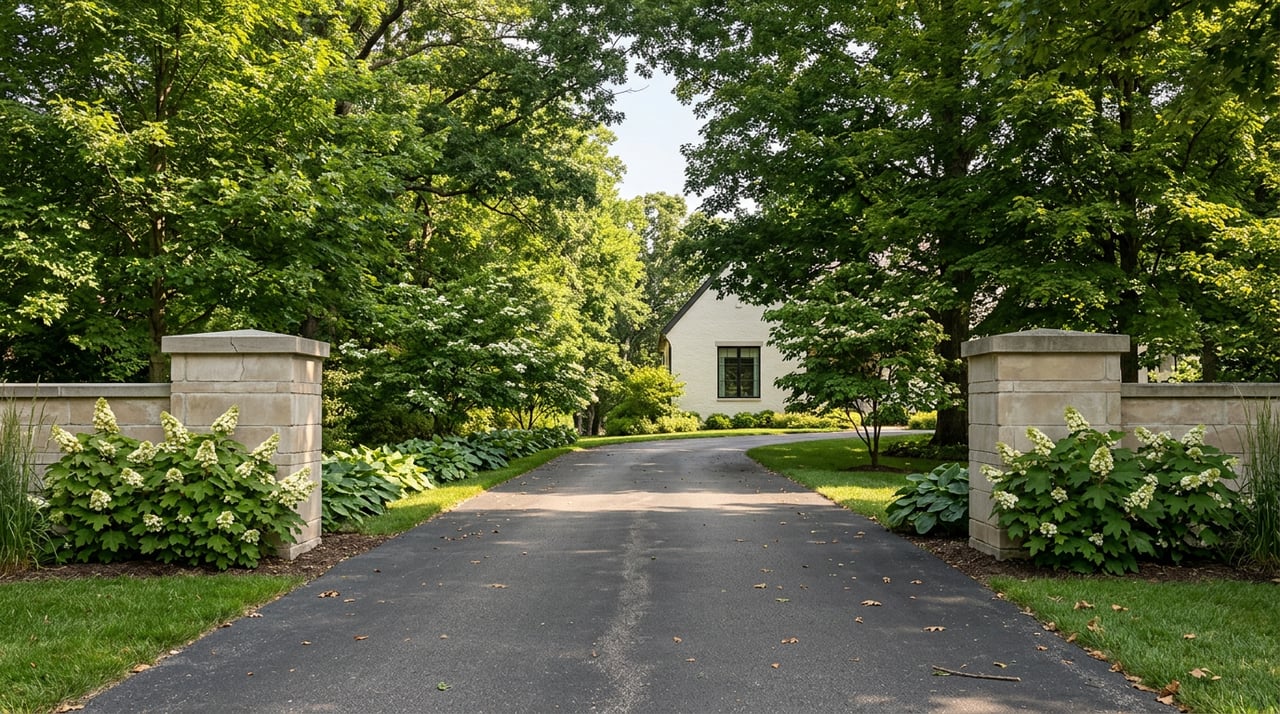
The reason the number won't hold still is the same reason Town and Country looks the way it does when you drive through it. A zoning code written to keep the city residential and lightly built limits how many homes exist, how often they change hands, and what kind of product can be added. Any median calculated from a handful of sales inside that constraint is going to lurch.
The rule that shapes every offer
Town and Country was incorporated in 1950 and used its new authority to do one specific thing: zone itself exclusively residential, set a one-acre minimum lot size, and prohibit commercial and industrial development, an ethos that has held for more than seventy-five years and left the city with virtually no commercial land use. Growth here means larger homes on larger lots, not more homes.
The mechanical details a buyer should know before writing an offer:
- One-acre minimum, with larger tiers. The estate districts require substantially more. In some subdivisions, the code sets a four-acre minimum lot with at least two sides of the lot exceeding 300 feet in length and a minimum 150-foot width.
- Deep setbacks. In those same districts, residential structures must sit at least 50 feet from any property line, and non-residential structures at least 25 feet. A three-acre parcel with a bad setback geometry can build smaller than a two-acre parcel with a good one.
- A frontage carve-out for larger lots. Lots of three or more acres may front on a street with only a 35-foot right-of-way, versus the 50-foot minimum that applies elsewhere. This is why so many estates sit at the end of narrow, canopied private lanes.
- Tree protection with real dollars behind it. Developers must post a $25,000 surety bond per acre of woodlands preserved, and a tree-restoration escrow deposit based on the appraised value of every tree to be preserved is required before any development permit is issued. Renovating a wooded estate is not a paperwork exercise.
- One main structure per lot. The code allows only one main structure per residential lot across every residential district, which forecloses the accessory-dwelling plays that inflate value in other suburbs.
None of this is trivia. It is the reason the supply curve barely moves and the reason the median price is a poor summary statistic.
Why the median swings so hard
Because so few homes trade in any given month, the mix determines the median. When a single Price Road estate closes in a quiet January, the sale-price median jumps toward $2.5 million. When the month's activity leans toward the smaller-lot Kehrs Mill transition zone or an entry-tier villa, the list-price median settles back near $870,000. The Zillow index sits in the middle at roughly $1.18 million because it smooths across the whole housing stock rather than the transaction sample.
For a buyer, the practical reading is that a "market median" in Town and Country is not a price expectation. It is an artifact of which corner of the city happened to trade last month.
What your money actually buys, by corridor
The city is not one market. It is at least four, and the boundaries track the age of the homes and the lot sizes as much as the streets.
| Corridor | Typical stock | Lot pattern | How it trades |
|---|---|---|---|
| Price Road / Wild Horse Creek Road | 1960s–1980s brick colonials, French country estates, and ranch-style houses with expansive guest wings | Two to three acres, often more | Trades within families for generations; multi-million-dollar sales when they surface |
| Kehrs Mill Road (western transition to Chesterfield) | Late 1990s through 2010s builds, 5,000 to 8,000 square feet common | Smaller than the estate parcels in the western half of the city | Faster turnover; the family-scale entry into the T&C address |
| Ladue Road eastern edge | Among the most established stock, some parcels tracing back to the original farmstead era, occasional carriage house or guest cottage on a larger estate | Mixed, often generational | Rare openings; buyer pool overlaps with Ladue and Clayton |
| Woods Mill Crossing (Hwy 141 / I-64) | New McBride Homes upscale condominiums | Attached, no acreage | New construction pipeline, delivering through 2026 |
The table is not a ranking. It is a reminder that the same city can produce a $2.5 million transaction and an $875,000 transaction in the same week without either being an outlier.
The Planned Development escape hatch
The one-acre minimum and the residential-only posture leave essentially no path for new attached product on ordinary lots. What you see going up instead are rezonings to Planned Development districts, approved parcel by parcel and often carrying long moratoriums against further change.
The three currently on the map:
- Woods Mill Crossing (MUD-1). Roughly 11.58 acres south of South Outer Forty Road and west of South Woodsmill Road, rezoned from Commercial to a Mixed Use Development district for multi-family residential and commercial uses. This is where McBride Homes' new Willow floorplan is debuting, with 2- and 3-bedroom condos featuring 2.5 baths, open-concept living, 9-foot ceilings, and roughly 1,800 square feet, delivering fall and winter 2026 at Highway 141 and 40.
- Town Square (PD-2). 8.811 acres south of Clayton Road and east of South Mason Road, rezoned from Suburban Estate and Commercial to a Planned Development district for retail, office and public uses.
- Mason Pointe (PD-1). 33.427 acres south of South Outer Forty and west of South Mason Road, rezoned to a Planned Development for nursing home, assisted living and continuum-of-care uses, with a ten-year moratorium on any further amendment to the zoning or site plan.
For a buyer who wants the Town and Country address without the acreage management, the PD districts are effectively the only supply. That scarcity is doing real work in the pricing.
The transaction friction most buyers don't see coming
A few practical items that separate a smooth Town and Country closing from a stalled one:
Renovation timelines assume tree escrows. If a project touches woodland or requires clearing near mature specimens, the escrow deposit and the arborist supervision requirements are not optional. Underwriting a renovation budget without them will produce a number that misses reality.
Private-road access changes the diligence list. Estates on 35-foot right-of-way lanes carry maintenance obligations that public-street buyers rarely encounter. Ask for the road agreement early.
Off-market flow is real on the estate spine. Along Price Road and Wild Horse Creek Road, homes often move through relationships before they ever hit the MLS. A buyer relying solely on portal alerts will miss the inventory that best fits the search.
Site Plan Review applies to planned residential communities. The city requires that all nonresidential developments and subdivisions being developed as planned residential communities go through a Site Plan Review process. If your target is a new-build lot in a planned subdivision, budget for that timeline.
FAQ
Is the market moving faster or slower than a year ago? It depends on which slice you measure. One market read shows a June 2026 median 145 days on market, roughly the same as June 2025. Another shows a January 2026 sample selling in 4 days on the market compared with 34 the year before, on six closings. The estate spine trades slowly and quietly. The smaller-lot and condo tiers move faster. Averaging them hides both signals.
Can I subdivide a large lot to build a second home? No. The code permits only one main structure per residential lot, and subdivision must clear the city's review process. Assume a large lot is a single-house lot unless a land-use attorney tells you otherwise.
Why do so many new condos suddenly exist in a residential-only city? Because they aren't in the estate or suburban-estate districts. They sit inside rezoned Planned Development parcels, each one an individual ordinance. That's why the new supply is concentrated at Woods Mill Crossing and a handful of other named PDs rather than scattered across the city.
What's the best way to see homes that never hit the portals? Work with an advisor who is inside the estate-owner network on the Price Road and Wild Horse Creek corridors and who tracks the PD delivery calendar for the new attached product. The public feeds will show you a fraction of what actually trades.
If you are weighing Town and Country against the other central-corridor suburbs, or you own a home here and want a clear read on where your property sits inside this split market, Liz McDonald can walk you through the specific corridor economics and give you a targeted valuation. Request your free home valuation to start the conversation.